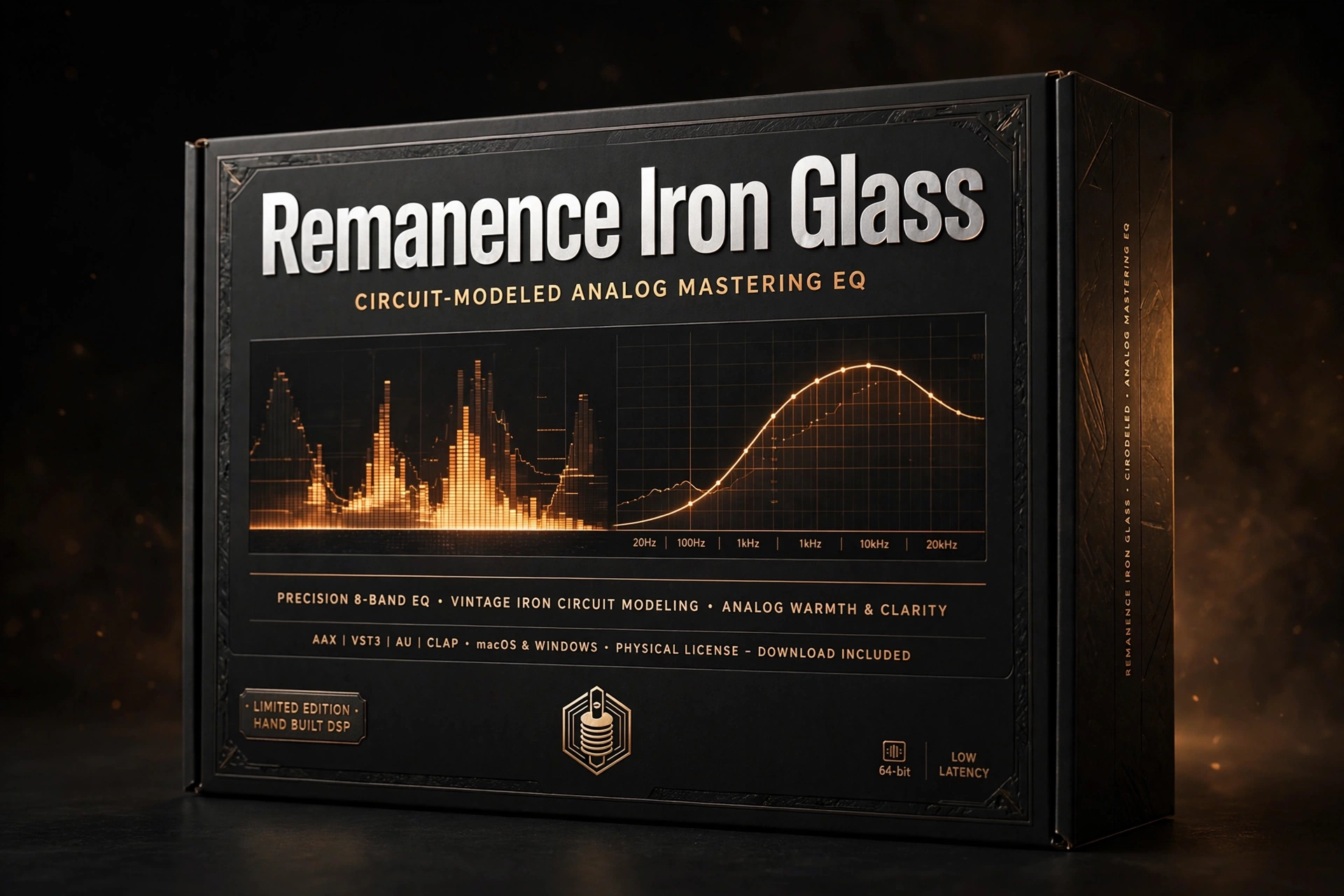
Remanence Iron Glass is a circuit-modeled mastering EQ that treats analog character as part of the equalization itself rather than a layer added afterward. Built around five parallel EQ bands, the plugin models tubes, transformers and an inductor network as interacting circuit stages, so every frequency move passes through genuine hardware-style behavior instead of a clean digital gain change with saturation on top. For mastering engineers, that means tone shaping and weight arrive in a single gesture — exactly what you want from the last EQ in the chain.
How the iron glass circuit model actually works
Iron Glass began life as a free JSFX experiment, and that origin shaped its philosophy. The early version approximated analog behavior with stacked DSP layers; the commercial release went further, modeling the tube stages, transformers and inductor network as real circuit elements. The practical difference shows in how the processor responds: drive the input harder and the whole EQ reacts the way hardware does, with harmonic content and transient behavior shifting together rather than a separate saturation knob doing its own thing. Remanence Audio even named the company after transformer remanence — the magnetic memory iron retains after saturation — and that lingering behavior after transients is baked into the model.
Key features of remanence iron glass
- Five parallel EQ bands in a passive-style architecture for broad, musical tone shaping
- Circuit-modeled tube stages with dedicated character controls beyond simple drive
- Transformer modeling that reproduces saturation memory after transients
- Modeled inductor network forming the heart of the filter sections
- High-pass and low-pass filters built from the modeled circuitry, not generic digital filters
- Input and output gain controls (±18 dB) for dialing circuit drive and matching levels
- Fully offline licensing with a functional 14-day trial included
Using iron glass on the mix bus and in mastering
On a stereo mix bus, small EQ moves combined with gentle circuit drive give a mix extra density and tonal glue without a chain of separate plugins. In mastering, the parallel design handles broad strokes — low-end weight, midrange clarity, top-end air — while the modeled stages contribute character that keeps the result from sounding sterile. The key is restraint: like hardware mastering EQs, small changes here produce surprisingly large perceived differences. On individual tracks such as vocals, drums or bass, pushing the drive harder turns the same processor into a creative coloration tool.
Who is remanence iron glass for?
Remanence iron glass suits mastering engineers who want analog-style weight without chaining a separate EQ and saturator, and mix engineers who like a touch of circuit color on the mix bus. Producers working on vocals, drums, bass or synths will find the individual-track applications just as useful when the goal is character rather than surgical correction. If your workflow already leans on clean digital EQ, Iron Glass is the complementary tool for the moments when a mix needs glue and tone in one pass.
Tech specs and compatibility
Iron Glass runs on macOS 11 and later (Intel and Apple Silicon universal binary) in VST3, AU and AAX formats, and on 64-bit Windows 10 and later in VST3 and AAX. Licensing is fully offline with no internet connection required, and a fully functional 14-day trial lets you evaluate it on real sessions before buying.
Remanence iron glass FAQ
Is remanence iron glass only for mastering?
No. The five-band parallel design makes it a natural mastering EQ, but it works equally well on mix buses, drum buses, vocal buses and individual tracks — just drive the input harder when you want obvious coloration instead of subtle glue.
How is parallel EQ different from a normal serial EQ?
In a serial EQ each band feeds the next, so boosts accumulate. Iron Glass processes its five bands in parallel and blends them back together, which keeps broad tonal moves musical and avoids the buildup you get from cascading stages.
Does remanence iron glass need an internet connection?
No. Licensing is fully offline, so the plugin runs fine on studio machines that never touch the network.
If your masters need analog weight without a hardware budget, remanence iron glass belongs on your shortlist — and the Plugboutique deal price makes it an easy decision. Grab it now and hear what circuit-modeled EQ does for your next master.
Explore more Mix & Master Plugins at Plugboutique, or pair it with WG DAW Converter – Move Sessions Between DAWs Easily for an even bigger toolkit. Also listed on PluginsBoutique.





 Download instantly from Plugboutique
 Instant Digital Delivery



 Free 2-Day returns if not work












Reviews
Clear filtersThere are no reviews yet.